Community Energy
Generational energy infrastructure must be community or publicly owned to deliver the best long-term socio-economic value.
CLEAN HEAT, STREET BY STREET.
To secure clean heat for the future, we need investment approaches that extend beyond commercial and political cycles.
Cathedral Thinking for Energy Security.
Across Scandinavia, heat networks are treated as long-term public infrastructure, often owned by municipalities or community bodies and operated for the benefit of the people they serve. Surpluses are not extracted as profit; they are reinvested into the system itself to keep it reliable, expand capacity, upgrade technologies, or reduce bills the following year.
Built to Last. Owned by All.
Shetland Heat Energy & Power (SHEAP) offers one of the clearest UK examples of long-term, community-anchored heat infrastructure. Developed to serve local needs rather than commercial returns, it has delivered reliable, affordable heat for decades while steadily expanding and reinvesting in the network. Its success shows how publicly rooted ownership and long-term planning can provide stable, low-carbon heat and genuine socio-economic value, a model of cathedral thinking that demonstrates what is possible when regions invest with future generations in mind.
Energy Resilience Starts with Heat.
Heat networks strengthen national resilience by using every available energy source: waste heat, renewables, surplus electricity and existing fuels. By harvesting energy that would otherwise be lost, they reduce reliance on imports and ease pressure on the grid.
A National Plan for Local Heat
This requires a national financing framework based on long-term, low-interest, government-backed loans, mirroring the proven Scandinavian model. It also calls for institutions, such as Great British Energy, to take responsibility for enabling generational investment in heat grids, not just short-term pilots.
Communities and councils can begin now by planning integrated, future-ready locally owned networks.

ENERGY STRATEGIES
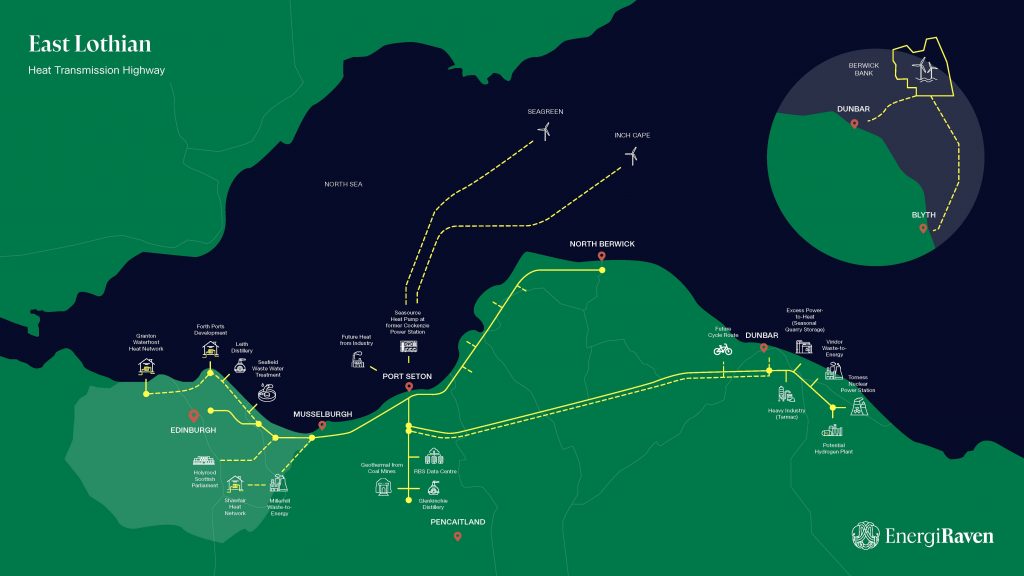
Regional-scale heat transmission infrastructure, also known as Heat Highways, is the mechanism for transporting waste heat over long distances.
Linking renewable electricity with heat networks and thermal storage becomes a powerful tool for the future UK energy system.
Green Energi Havens can unlock the full potential of British energy, creating a future where nothing goes to waste.
A ONCE IN A GENERATION OPPORTUNITY.
East Lothian has the chance to lead Scotland in delivering the UK’s first large-scale regional heat transmission highway – capturing abundant waste heat from industry, data centres, and renewable energy, and distributing it through a community-owned network.
By linking electricity, heat, and thermal storage, the network enables a more efficient, flexible energy system – a principle known as sector coupling. This ensures that Scotland’s renewables are used to their fullest potential.
A new feasibility study, led by Danish heat network specialists Viegand Maagøe, confirms the project is both technically sound and economically competitive – offering heat cheaper than individual heat pumps, while unlocking local jobs, energy security, and climate action.
FURTHER READING


FAQ
The main purpose of community or publicly owned energy infrastructure, such as heat networks, is to deliver the best long-term socio-economic value for the local area. This approach, often seen in Scandinavia, ensures that surpluses are reinvested into the system rather than extracted as profit, keeping bills low, reliability high, and enabling continued expansion and technological upgrades for the benefit of the community.
Community-owned heat networks strengthen national energy resilience by utilising a wide range of local energy sources, including waste heat, renewables, surplus electricity, and existing fuels. By harvesting energy that would otherwise be lost, these networks reduce reliance on imports and ease pressure on the national grid, making the overall energy system more secure and resilient.
The white papers recommend a national financing framework based on long-term, low-interest, government-backed loans, mirroring the proven Scandinavian model. This type of financing allows for the necessary generational investment in heat grids, rather than relying on short-term commercial or political cycles. Institutions like Great British Energy are called upon to enable this long-term, community-focused approach.
Linking heat networks with renewable electricity and thermal storage, a principle known as 'sector coupling', unlocks the full potential of British energy by ensuring that the country's renewable resources are used to their fullest extent. This integrated approach creates a more efficient and flexible energy system, where nothing goes to waste.
East Lothian has the chance to lead Scotland in delivering the UK's first large-scale regional heat transmission highway, capturing abundant waste heat from industry, data centres, and renewable energy, and distributing it through a community-owned network. A new feasibility study has confirmed that this project is both technically sound and economically competitive, offering heat cheaper than individual heat pumps, while also unlocking local jobs, energy security, and climate action.