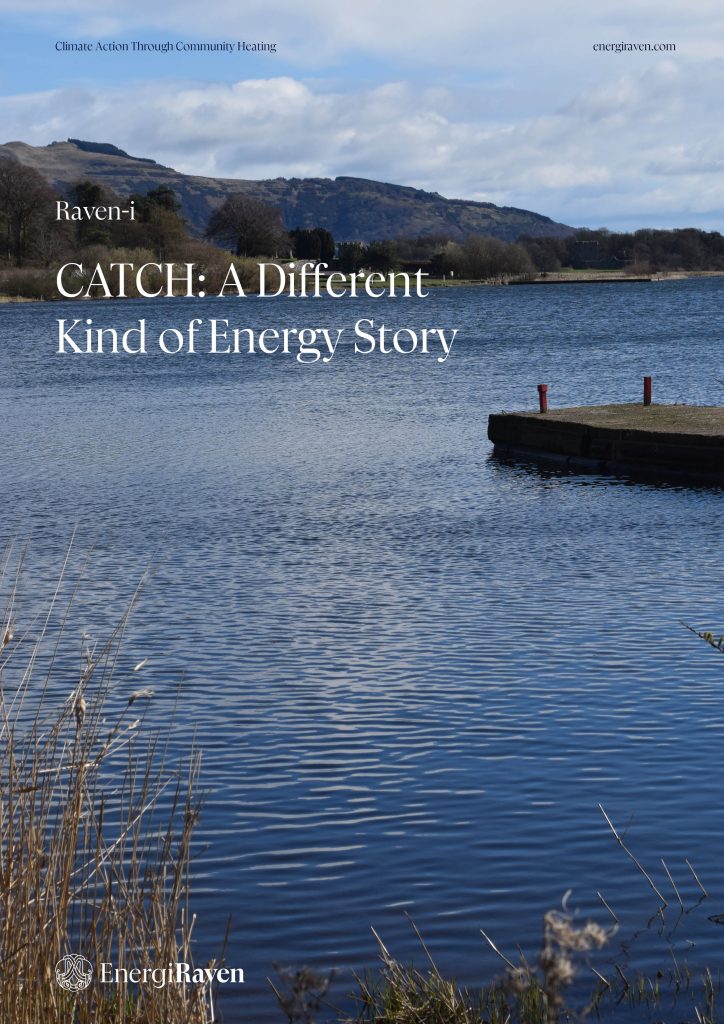
A healthier loch, warmer homes, lower bills, and more value staying in the community – that is the story at the heart of CATCH: A Different Kind of Energy Story. Set around Loch Leven, Kinross and Milnathort, it imagines a future where environmental repair and affordable local heat are not competing priorities, but part of the same solution.
Loch Leven is one of Scotland’s most important freshwater places, central to local identity, wildlife, recreation, and the wider economy. But the loch is under pressure. Nutrient loading and algal blooms are visible reminders that this is a living system under strain. At the same time, the surrounding towns face a different but equally pressing problem: the cost of heat. In older communities with many stone-built homes, staying warm can be expensive, and moving away from fossil fuels is not always simple or affordable on a house-by-house basis.
What makes this story so compelling is the way it links those two realities. Instead of treating the loch’s health and the area’s heating needs as separate challenges, CATCH shows how one could help solve the other.
The idea is rooted in a circular system. Biochar, made from local biomass, could be used to capture phosphates from tributaries and wetlands before they reach the loch in damaging quantities. Those recovered nutrients could then be returned to land, creating a “fields to loch to biochar to fields” cycle that reduces pollution while supporting agriculture. But that is only part of the story. Producing biochar also creates substantial heat, heat that could be recovered, stored, and used to supply a district heating network serving homes and buildings in Kinross and Milnathort.
That means the benefits are not abstract. A cleaner loch could sit alongside a more stable and resilient heat supply. Local households could be less exposed to volatile fuel prices. Older buildings that are difficult to decarbonise individually could connect to shared infrastructure over time. Farmers could benefit from a more circular nutrient model. And the wider community could gain from an asset designed to keep environmental, economic, and social value closer to home.
There is also something bigger in this vision. It suggests a different way of thinking about climate action – not as sacrifice, and not as a distant policy goal, but as practical place-based improvement. Clean up the loch. Use local resources wisely. Capture and store heat. Build infrastructure that serves people for decades. Keep the benefits rooted in the community. The system diagram in the document shows exactly how these parts connect, from wetlands and tributaries to biochar production, heat recovery, thermal storage, and a district heating network.
This is what makes the story worth reading: it is hopeful, but grounded; ambitious, but practical. It offers a vision for Kinross and Milnathort where restoring nature, cutting emissions, and reducing heating costs all reinforce one another. That is a powerful local story – and one with lessons far beyond Loch Leven.
Drax has become a familiar subject of controversy, scrutinised by campaigners, journalists and Parliament alike. Much of that attention has focused on the origins of the fuel it burns. Far less attention has been paid to the energy it wastes.
For decades, one of the country’s largest power stations has rejected vast quantities of usable heat into the atmosphere and the River Ouse. This was not the result of neglect or error, but a symptom of an energy system designed to prioritise electricity alone. Heat was never treated as infrastructure; it was something to be managed locally, or not at all. That assumption held while gas was cheap, abundant and geopolitically convenient. It no longer does.